Sunday Crumb was first.
A real Greenville bakery, on her own domain, running her own list. Not a mockup.
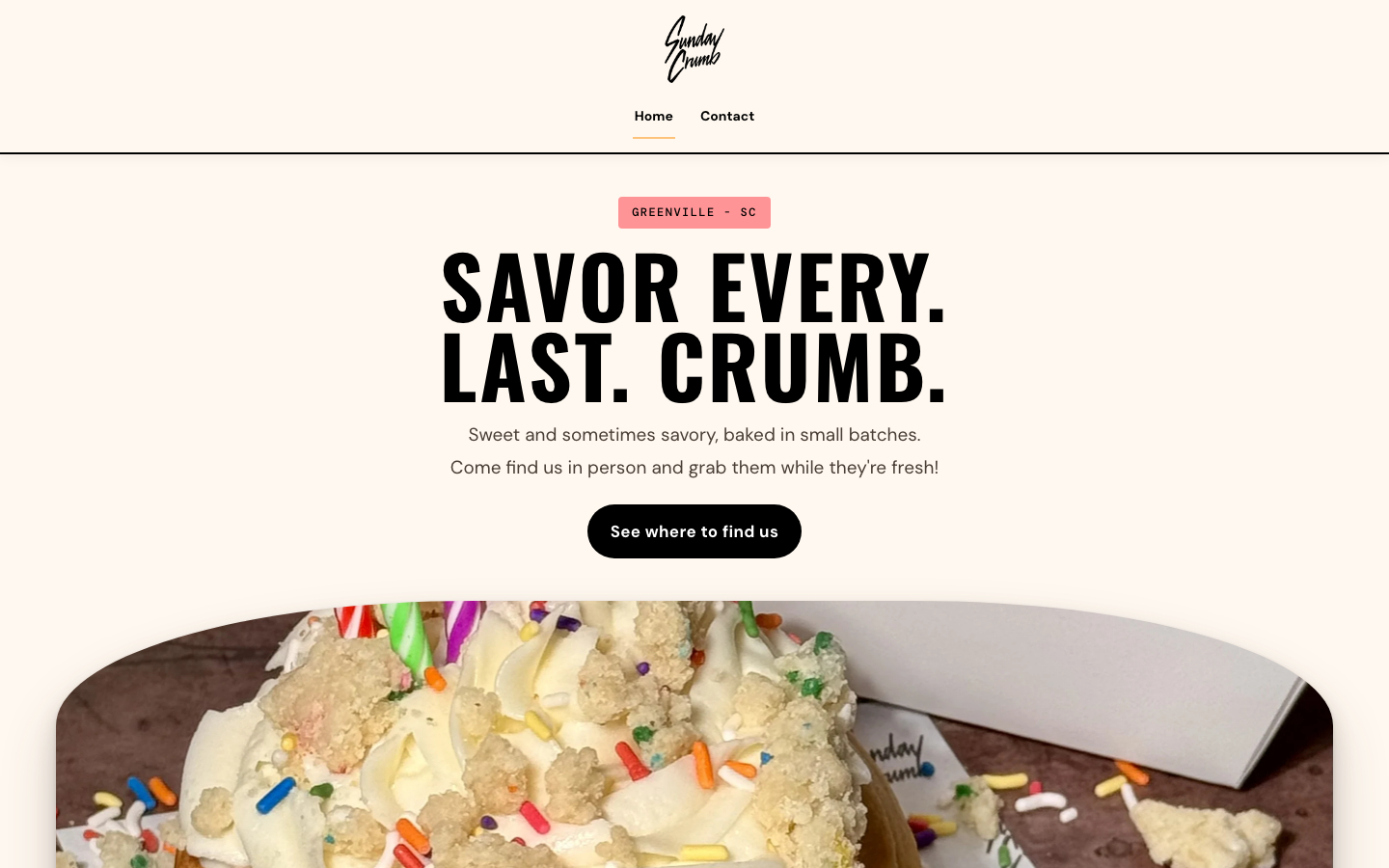
sundaycrumb.com, live today
Visit the site →
551subscribers imported clean
3tools replaced with one login
$0cut of her sales
What she needed
Sierra runs Sunday Crumb, a Greenville bakery selling by pop-up and pre-order, not a storefront. She came to us with 551 people on an email list she wasn't sending to, because the list lived in Flodesk, the site was a locked Shopify page, and her domain sat in a third account (Google Domains, since sold to Squarespace, which she didn't even know). Three logins, none of which talked to each other.
- A simple landing page, deliberately not a store. Her words: "yes we have a website, yes we have basic information, but you can't order online." She wants people to find her in person, not check out from a cart.
- An email hub inside the site, replacing Flodesk. Her spec was the Squarespace mental model: log in, click Email, send to her list, all in the same place as the site.
- Request forms that don't lose a lead. Pop-up invitations and corporate orders were getting lost in Instagram DMs.
- A "where to find us this weekend" block she updates herself, so people stop depending on catching her Instagram story.
- Explicitly not needed: online payments. She already uses Square for in-person sales and has no complaints about it.
- One hard constraint, repeated twice on the call: "the simpler the better, and the ease of it for me on the back end the better too."
What we did
- Untangled her domain and mail first, since it was actively losing her inbound order requests. Her MX record pointed at Google's outbound relay, not an inbound mail exchanger, so anyone emailing her was silently bouncing.
- Moved all 551 subscribers over with zero unsubscribes mailed, off Flodesk and into an email hub built into her own site.
- Built her real site at sundaycrumb.com: her own brand, her own photography, on her own domain, replacing the locked Shopify page.
- Shipped three request forms (pop-up invitations, corporate orders, partnerships) that email her directly instead of getting buried in DMs.
- Left ordering switched off, on purpose. It's part of her account either way, so if she ever wants it, it's a switch, not a new project. She didn't ask for it, so we didn't turn it on just because Batch can.
In her own words
"The simpler the better, and the ease of it for me on the back end the better too." She wanted a tool without a lot of screens, and that's what shaped every decision above.
Want to be next?
A few founding spots are left, at half off setup.